How to Start Investing with $100: A Beginner's Guide to Low-Cost Brokerage Accounts
A hundred dollars can feel like an awkward amount to invest. It's real money, but it isn't much. The mechanics have changed, though: online commissions have mostly disappeared at large brokers, minimums are often zero, and fractional shares let you buy into a fund without buying a whole share. What follows is a practical path from opening an account to owning a small, sensible portfolio.
The first goal with $100 isn't a big return. It's building the habit and the plumbing: an account, a funding method, one fund you understand, and a routine for adding to it. The person who invests $100 and adds $50 a month for years ends up far ahead of the person still waiting until they have $5,000.
Small accounts also make mistakes cheap. If you put $100 into something you later decide you don't want, you've paid a few dollars for a lesson instead of a few thousand.
For an account this size, the features that matter are plain:
Two other things worth knowing: your investments are typically held by the brokerage as custodian, and SIPC coverage protects you if the broker fails — not if the market falls. Market losses are yours to bear, which is exactly why you keep the portfolio boring.
Applications are usually online and take ten or fifteen minutes. Have these ready:
Before any of this, make sure the $100 isn't money you'll need for rent or an emergency this year. Clearing high-interest debt and keeping some cash on hand both come first. If your situation is complicated, an hour with a fee-only financial planner or tax professional is money well spent.
A fractional share is a slice of a whole one. If an ETF trades at $400 and you have $100, you buy a quarter share. Your money tracks the fund's return in proportion to what you own, and dividends are paid out the same way.
Two caveats. Not every broker offers fractional trading on everything, and some fill fractional orders only during set windows rather than instantly. Fractional slices can also be awkward to transfer to another broker; they're often sold and moved as cash. Neither issue matters much when you're starting. If fractional shares aren't available to you, index mutual funds are a good substitute, since many let you invest any dollar amount.
With $100, boring is the right answer. One broad, low-cost index fund gives you hundreds of companies in a single purchase. A total US stock market ETF or a broad index mutual fund is a perfectly respectable first holding.
If you want a little diversification from the start, a simple split might look like this:
Those percentages are a way to think about balance, not a personal recommendation. Your time frame and your tolerance for volatility should drive the mix. Someone with decades ahead can hold little or nothing in bonds; someone investing for a goal five years out should be far more cautious.
What to avoid with a first $100: individual stocks you heard about at work, a dozen different funds, leveraged or inverse products, and anything with an expense ratio above 1%. The expense ratio is the annual fee a fund takes. Low-cost index funds charge a fraction of a percent, while some actively managed funds charge more than 1%. On $100 the difference is pennies. Over decades it adds up — so learn to check that number now.
Once the account is open, set a recurring transfer. Twenty-five or fifty dollars a month, invested automatically, does more for you than reading market news every morning. Check the account quarterly, not daily; price swings are normal and mostly meaningless in the short run.
Boring and automatic beats clever and occasional, especially with a small account.
Once a year, confirm your mix still matches your plan, and raise your contribution when your income rises.
The first $100 is mostly about proving
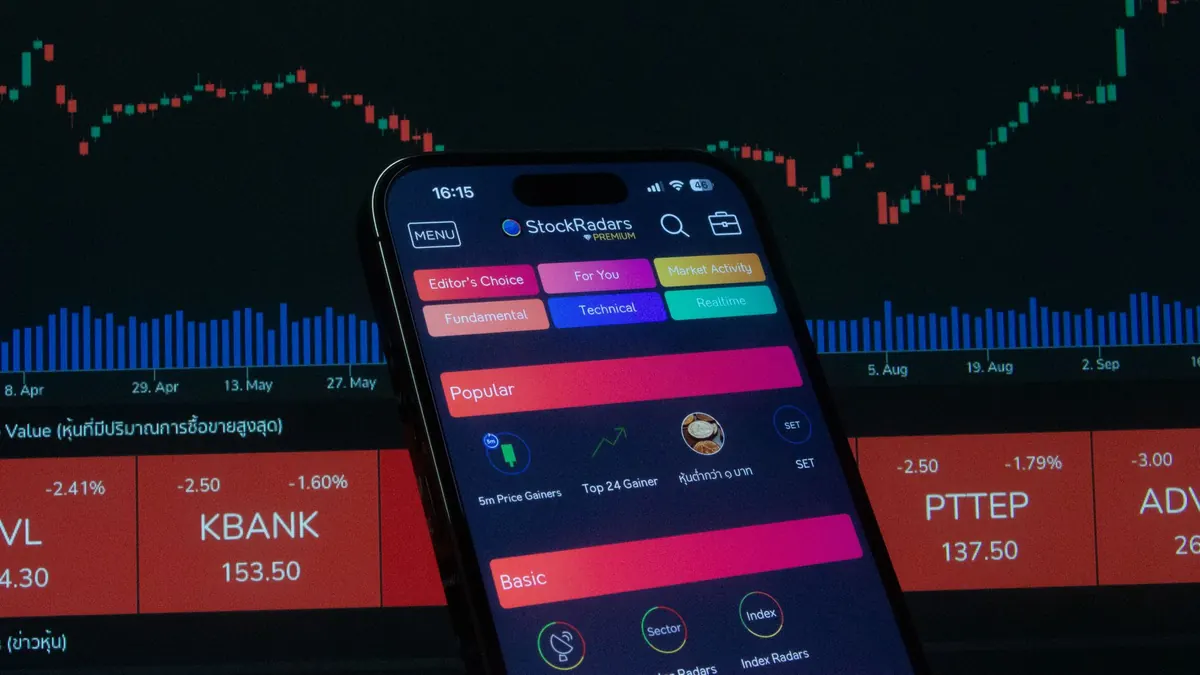
Photo: StockRadars Co., / Pexels